
Reflection #118 (25th January 2026 at Essex Church / Kensington Unitarians)
‘Being fully alive requires both finding trusted others as well as being a trusted other. For trusting and being trusted allow us to blossom.’ Those words from Mark Nepo are at the heart of what today’s service is all about – and I believe his message, it rings true to me – we humans need to trust, and feel trusted, in order to be fully alive. Yet I guess most of us will have had experiences – some small incidents, some devastating – of having trusted a person, or an institution, and having that work out badly for us, when our trust was broken, or abused, or taken advantage of. We know, don’t we, that this troubled and often terrifying world is full of peril and risk. So it’s understandable that we might retreat into a state of being wary and defended to protect ourselves from harm.
Let’s just pause for a moment to consider (and hopefully clarify) what it is that we mean by trust. One of the dictionary definitions that I like best for ‘trust’ is this: ‘to believe that someone is good and honest and will not harm you, or that something is safe and reliable’; that is, we need to have trust in situations in which we are in some way vulnerable. One way to think about trust, and trusting, is as putting yourself – or something especially precious to you – into the hands of another. We might put our body into the hands of a surgeon – or a lover – both of these require great trust. We might put our heart (in a less literal sense) into the hands of a beloved or a friend as we share intimacies and confide in them – trusting that they will be kind and loving in response. On a rather more mundane level we might put our spare house keys in the hands of a neighbour, trusting them with access to our home and possessions, or trusting them to cat-sit or dog-sit, or water our tomatoes, while we’re away. I’m sure you can think of lots of other instances where trust is woven into daily life.
It is risky to trust – to put ourselves into the hands of others – but if we never take such risks then we can become closed-off, and isolated, and miss out on so much in life. We might end our days realising we have not lived and loved as fully as we could have. But there is always a leap of faith involved in deciding to trust. We don’t know how it will turn out. There’s a short and slightly ominous quote from Ernest Hemingway on this, which acknowledges our trust will sometimes be misplaced and we can’t know for sure. He said: ‘The best way to find out if you can trust somebody is to trust them.’
A more light-hearted take on the dilemma of trust is encapsulated in these words by Lemony Snicket, who wrote: ‘Deciding whether or not to trust a person is like deciding whether or not to climb a tree, because you might get a wonderful view from the highest branch, or you might simply get covered in sap, and for this reason many people choose to spend their time alone and indoors where it is harder to get a splinter.’ And this in turn links back to the quote from Frank Crane that I shared at the top of the service: ‘You may be deceived if you trust too much, but you will live in torment if you don’t trust enough… We’re never so vulnerable than when we trust someone – but paradoxically, if we cannot trust, neither can we find love or joy.’
Some of us might have a more trusting temperament and others may be naturally wary. I came across some thoughts on this from UUs Christine Robinson and Alicia Hawkins, who write of the basic trust which, if we are well cared for, we learn as infants – the inner sense that ‘I can trust the world. I know what to expect. I will be cared for. It’s OK.’ They continue: ‘Over our lives, we build on our foundation of basic trust with specific experiences of trust, gullibility, cynicism, and reconciliation after breaches of trust. Our experiences give us a sort of default trust setting, an attitude with which we face the world. Our default setting not only shapes our own feelings and behaviour, it also shapes the way others behave toward us. It might seem that a cynical attitude is safest, but since people who sense they are not trusted often withdraw from relationship, and sometimes even act in untrustworthy ways, it is actually a terrible risk. And while the happy-go-lucky, “trust the universe” stance might seem like an advanced spiritual practice, in actuality, it can invite exploitation.’ Words from Robinson and Hawkins.
While I was pondering this subject during the week I found myself thinking about the temperamental variation of cats and dogs as a model for thinking about trust (in fact on Friday I was in a ministers’ meeting with my colleagues Laura and Michael, where Laura’s dog Bess and Michael’s cat Willow were also in attendance, and as I don’t have any pets I took the opportunity to consult them all on this matter). I observe that some pets are self-contained, wary, and slow to trust, preferring to keep their distance; while others are utterly unboundaried, intuitively open, and demanding of love, affection, and belly rubs! My Instagram feed has ended up with a lot of cat and dog videos on it – I’m only human! – in the last week I’ve seen a lot of ‘clingy cats’ demanding cuddles (bucking the cat stereotype) – but I usually get loads of videos of kind and patient carers in animal rescue shelters doing the slow work of regaining the trust of animals who have been neglected or abused. Sometimes you get to see the long story unfold, where a dog that starts out trembling with fear in the corner of a cage, averting its eyes and making itself small, will eventually very tentatively approach the carer, then maybe allow itself to be cuddled, and you’ll see a little wag of its tail… and by the end of the video it’s all belly rubs and exuberant joy! Clearly this is often a long, painful process – but it’s an incredible model of trust-building – and it’s not too much of a stretch to see parallels in many of our human relations.
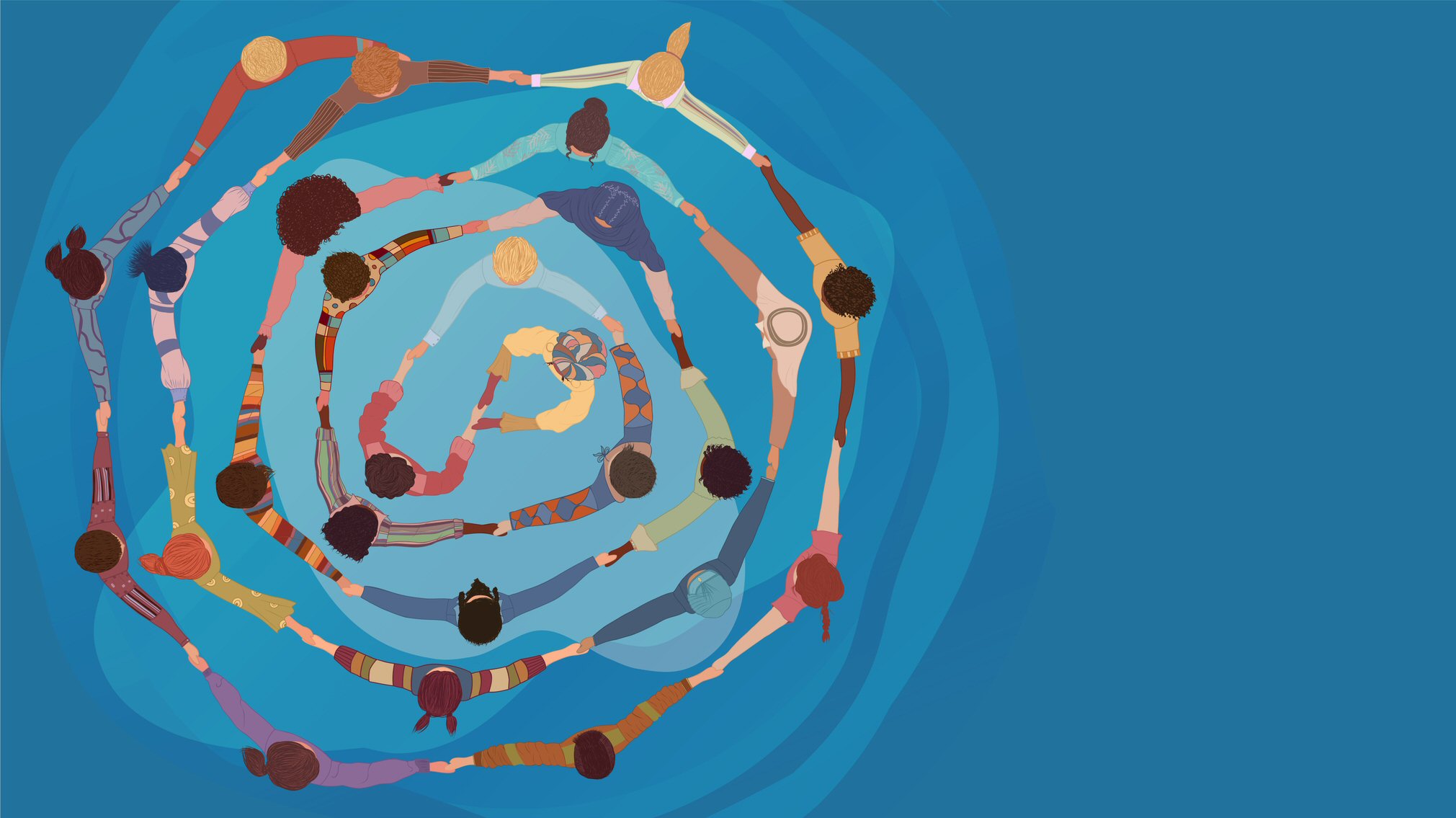
We each need to discern for ourselves who we can trust and who we can’t. Or perhaps I should say when we can trust and when we can’t – there may be people we can trust in some domains but not others – there’s an element of context dependence here, I think. In each moment we need to consider what might be gained and what might be lost by taking the risk of being more trusting and open. We won’t (and we shouldn’t) trust everyone equally all the time. We need to set boundaries for our own protection. Each of us is probably aware, of the different levels of trust we have with others, radiating out in concentric circles. We’ll most likely have an ‘inner circle’ of close confidantes, who we trust to share the intimate details of our lives, and trusted comrades who we can rely on to give us practical support and encouragement. Some of you have probably taken part in an exercise called the ‘Trusted Ten’ – it comes up a lot in diversity and equalities training (and I’m not going to focus on that aspect of the exercise today but it’s an interesting and important thing to reflect on the make-up of the ten) – but if you want to have a go it simply asks you to make a list of the ten people you trust the most. Then reflect on why you trust them, what it is that makes them trustworthy, to you. Perhaps there might be echoes of the qualities we heard from Brené Brown earlier.
I’m interested in how we might create the conditions for deepening trust – whether that’s in the context of our personal relationships, or our community, or in the world – and I think they’re all linked up anyway. That’s why I so loved the poem we heard from Rosemerry Wahtola Trommer, with the image of stopping what she was doing to be fully present, give her time and attention to her daughter, and those beautiful, inspiring, closing lines: ‘To foster one moment of trust and love is to belong to a crucial revolution. It matters, how we hold each other. What happens everywhere starts right here.’ And Mark Nepo said something similar about how the trust we build at a micro scale can have an impact that travels further than we can possibly know. He said: ‘Let this be a reminder to seek those connections and to be that safe place for someone else. In doing so, we invite the blossoming of not just ourselves, but the world around us.’
I mentioned at the start of the service that the title ‘Circles of Trust’ was borrowed from the oft-quoted Parker J. Palmer. It’s a phrase he uses for a certain way of holding space for small groups – very much like our own Unitarian Engagement Groups – these groups have a very particular structure which is intended to cultivate deeper trust and make space for the soul to emerge. So I want to share an extended extract from him on this – a few paragraphs from his book ‘A Hidden Wholeness’ – Parker J. Palmer says this:
‘The soul is like a wild animal…tough, resilient, resourceful, savvy, and self-sufficient: it knows how to survive in hard places… Yet despite its toughness, the soul is also shy. Just like a wild animal, it seeks safety in the dense underbrush, especially when other people are around. If we want to see a wild animal, we know that the last thing we should do is go crashing through the woods yelling for it to come out. But if we will walk quietly into the woods, sit patiently at the base of a tree, breathe with the earth, and fade into our surroundings, the wild creature we seek might put in an appearance. We may see it only briefly and only out of the corner of an eye—but the sight is a gift we will always treasure as an end in itself.
Unfortunately, community in our culture too often means a group of people who go crashing through the woods together, scaring the soul away. In spaces ranging from congregations to classrooms, we preach and teach, assert and argue, claim and proclaim, admonish and advise, and generally behave in ways that drive everything original and wild into hiding. Under these conditions, the intellect, emotions, will and ego may emerge, but not the soul: we scare off all the soulful things, like respectful relationships, goodwill, and hope.
The people who help us grow toward true self offer unconditional love, neither judging us to be deficient nor trying to force us to change, but accepting us exactly as we are. And yet this unconditional love does not lead us to rest on our laurels. Instead, it surrounds us with a charged force field that makes us want to grow from the inside out—a force field that is safe enough to take the risks and endure the failures that growth requires. Circles of Trust combine unconditional love, or regard, with hopeful expectancy, creating a space that both safeguards and encourages the inner journey. In such a space, we are freed to hear our own truth, touch what brings us joy, become self-critical about our faults, and take risky steps toward change, knowing that we will be accepted no matter what the outcome.’
Words from Parker J. Palmer on ‘Circles of Trust’. I think his vision really resonates with what we’re trying to create here, in this beloved community, and I hope you’ll agree. Particularly in our Engagement Groups, gatherings like ‘Heart and Soul’, we’re making a clearing into which the shy wild animal of our soul can emerge. A safer, softer, kinder space, where – over time, given constancy – a deeper level of trust becomes possible. And this way of being might just be something we can carry with us, out into the rest of our lives, changing those around us, and spreading transformative trust into the world.
In that spirit, I want to close with a few prayerful words, based on a prayer from Matthew Smith, in hope that they might prepare our hearts for the days to come.
Spirit of Life, God of All Love,
In this moment let us be conscious
of the importance of trust in our lives.
While being open to others carries its risk,
we know our hearts will shrink and wizen
if we live mainly by wariness and suspicion.
Let us be willing to open ourselves up
to love and trust – for our own dear sakes.
There is good in the world,
and there is good in people.
Sometimes we need to look deeply – but it is there.
We know there are tens of millions of hearts
yearning for the same things that we do –
love, justice, care, compassion.
As we reach out, let us have resolute faith
that we will connect with those
true hearts – the companions
we really need for life’s journey.
So it is that we recognise and celebrate
this hard but invaluable work
of trusting and reaching out –
in our own personal lives,
and in the practise of spiritual community,
as we commit to creating a better world, together.
May it be so, for the greater good of all. Amen.
Reflection by Jane Blackall