
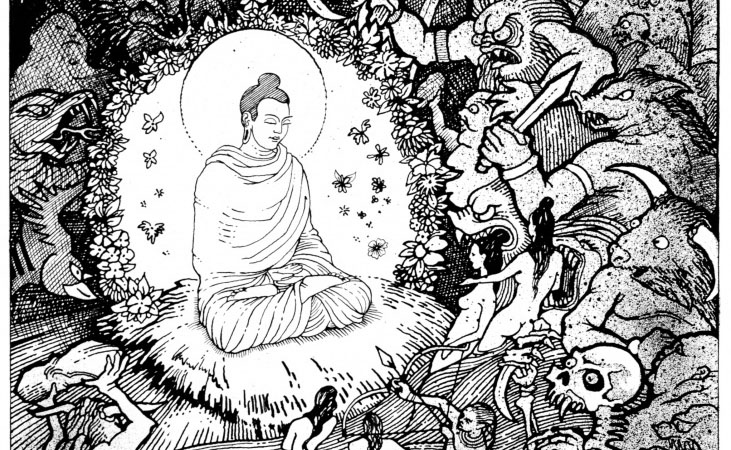
Reflection #120 (15th February 2025 at Essex Church / Kensington Unitarians)
I wonder how you respond to the story of the devil tempting Jesus, or the story of Mara tempting the Buddha? On today’s hymn sheet I’ve included an image of the latter story – which we’ll also show on screen for a moment – it’s a fantastical picture, by a Buddhist artist called Aloka, of the Buddha sitting serene in this bubble of light and flowers while every kind of snarling demon gangs up on him! All manner of beasts and horrors closing in.
Such images might make the stories seem far removed from our everyday concerns. But don’t we all have temptations we wrestle with? Habits of behaviour, or patterns of mind, that we find ourselves falling into again and again, perhaps despite our best intentions? Ways of being that aren’t healthy and which don’t represent our best selves. I would guess we’ve all had that experience of feeling ourselves drawn towards the irresistible thought or action. And possibly even thinking to ourselves ‘oh no, not again…’ as we do so. But, still, doing the thing we both do and we don’t want to do.
In this season of Lent people often think about temptation in relation to giving things up as a spiritual practice – a Lenten sacrifice – fasting from chocolate, or even cake (God forbid!). Or perhaps they’ll refrain from gossip, or swearing, or complaining. For some of us, though, the question of temptation is tied up with more serious addiction issues, those habits that are especially hard to break. For some there’s an ever-present temptation to drink, or use drugs, or gamble, and so on. If that’s the case for you, I hope you are getting the support you need, to help you take good care of yourself and make wise choices. UU Minister Marlin Lavanhar has this to say: ‘Temptation is real… and it can steal your future, and your family, and your freedom. And the best medicine is reaching out. Reaching out to others who care and can be trusted. Reaching out to God if you can. And reaching out in service to others so that your life has meaning and purpose… Have courage, for you are not alone.’
The temptations in the stories of Jesus and the Buddha seem to be of a slightly different nature. Temptations of the soul, perhaps. They’re depicted as devils or demons – and though most of us probably don’t believe in that literally, we do use that language colloquially, all the time – we talk about people ‘struggling with their demons’ – usually to mean that they have got some long-standing inner turmoil, and unhelpful, unhealthy, patterns of thought and behaviour. That’s what I want to focus on today. But such inner temptations can be more slippery to get hold of.
The Buddha was said to be tempted by greed, hatred, delusion (or ignorance). And Jesus was tempted by hunger, destruction, and influence. These are often characterised as temptations of ego, of desire for gratification, of wanting our own way. But as I tried to hint at in the meditation earlier, our temptations could go either way, for example, some of us aren’t so much tempted to inflate ourselves as we are to do ourselves down.
For me one of the biggest temptations of these times we are living through is the temptation to despair. The image I have put on the front of the order of service today
is a 15th century engraving (by a German artist known as Master E.S.) depicting the temptation to despair – we’ll just briefly pop it on screen – as you can see it shows a tormented man in bed surrounded by demons. This personification of the temptation to despair really speaks to me. The sense of all these voices crowding round your bed to tell you how hopeless everything is and what you should or shouldn’t be doing about it.
Padraig Ó Tuama interpreted Jesus’ temptation as him conducting a dialogue between his multiple selves (which made me think of Internal Family Systems for those of you who are familiar with that therapeutic model). In the wilderness away from all other distractions he was forced to face them and listen to their voices. The voices are asking ‘who am I to be?’ and ‘how am I supposed to be who it is I believe I am?’ These are questions of identity, calling, and purpose. And I think the point of these stories is that our various temptations divert us from our true self, our unique calling, our purpose. Similarly in the story of the Buddha and Mara he is being diverted from enlightenment.
If we find ourselves in the wilderness, this Lent, perhaps we can take it as an invitation to face up to our demons. And take a good look at ourselves. Listen to those voices. Because once we have some greater conscious awareness of our habits of behaviour and compulsive patterns of thought, we might have more freedom to choose. And let us remember those words of Joan Chittister to close: ‘Temptations are part of life… We grapple with them often – in some instances for our lifetime – before we come to realize that it is not so much the victory as it is the struggle that is holy.’ Amen.
Reflection by Jane Blackall
Bonus Meditation on Temptation:
We’re moving into a time of meditation now. To take us into stillness I’m going to invite you to begin your own personal reflection on this theme of ‘Temptation’. These stories of Jesus and the Buddha use very heightened symbolic imagery which might not be so easy to relate to the realities of our personal lives in the here and now. But as Joan Chittister said, ‘Temptations are part of life… We grapple with them often – in some instances for our lifetime – before we come to realize that it is not so much the victory as it is the struggle that is holy.’
After these prompts we’ll hold a few minutes of shared silence which will end with the sound of a bell. Then we’ll hear music for meditation. So let’s do what we need to do to get comfortable – adjust your position – put your feet flat on the floor to ground yourself – close your eyes. As ever, these words and music are just an offering, feel free to use this time to meditate in your own way.
So, as we move into a time of silence, I invite you to gently reflect on the temptations you habitually wrestle with. And let us do this in a spirit of the deepest self-compassion. As we heard in the last reading, Jesus and the Buddha looked their demons in the eye, and we are capable of facing up to our own demons too. Recognising those patterns and habits of behaviour we have that might be spiritually unhealthy, maybe detrimental to ourselves and those around us, and taking the first steps towards change. Even once we’ve seen and acknowledged these temptations, the struggle with them might well be life-long, but it will enable us to seek help, and reach out to trusted others. We don’t have to struggle on alone.
Maybe you are most troubled by material temptations. Habits around money or consumption. Compulsive behaviour with distractions that temporarily anaesthetise us from life’s sufferings. Substance misuse, or overworking, or thrill-seeking, or endless scrolling. Using people as things.
Or maybe you are more troubled by inner temptations. Habits of the soul. Patterns of thought. Maybe you are tempted to despair, in the face of the world’s troubles, or your own personal struggles. Or, conversely, to denial – turning away from reality – refusing to engage with it. Maybe you are tempted to think of yourself as entirely independent – a rock, an island – self-sufficient and needing nobody. Or, conversely, as entirely dependent – helpless, and hopeless. Maybe you are tempted to grandiosity, thinking everything is all about you, all down to you to fix. Or, conversely, maybe you are tempted to self-abnegation, thinking of yourself as a nobody, powerless.
Each of us has our own version of these inner struggles, these polarising tendencies, to wrestle with. Simply holding a gentle and kindly awareness of that which tempts us, or trips us up, in life can be a very helpful way to start to change our relationship with that aspect of ourselves. So, as we head into silence, let us look at our temptations clearly, and hold ourselves gently, in self-compassion.